
University of Tartu and partners publish the Andmering framework in Eesti Arst
Researchers at the University of Tartu and their partners have developed Andmering, a methodological framework that turns routinely collected health data into actionable feedback for clinicians and supports continuous improvement in the quality of care.
Estonia has collected digital health data for many years. The national Health Information System (TIS) has been in use since 2008 and is developed by the Health and Welfare Information Systems Centre (TEHIK). However, using these data to give clinicians regular feedback on their patients’ later care pathways and treatment outcomes has so far been limited.
A new article in Eesti Arst describes a methodological framework named Andmering. It shows how routinely collected care data can be used to assess quality of care on a recurring basis and to return the results to clinicians as feedback. The framework builds on the OMOP Common Data Model, an open, international standard that describes data from different sources in one analytical format. Researchers at the University of Tartu Institute of Computer Science, including Marek Oja and Jaak Vilo, have been converting Estonian health data to OMOP across projects and datasets for more than ten years. The framework also draws on the work of clinicians who initiated and built disease registries to follow what happens to their patients.
The first area of application is cardiovascular disease. The pilot study covers acute myocardial infarction, atrial fibrillation, heart failure, valvular heart disease and familial hypercholesterolaemia. It assesses which quality indicators can be calculated, validated and used as feedback with the data that already exist.
The authors of the paper are Riina Raudne, Artur Novek, Taavi Lai, Kerli Mooses, Monika Prits, Raivo Kolde, Patrick Pihelgas, Sulev Reisberg, Jaak Vilo and Alar Irs.
From concept to national infrastructure
Andmering took shape over the past year within the TeamPerMed Centre for Data-Enriched Personalised Medicine. It was co-created with the Estonian Health Insurance Fund (Tervisekassa), which was involved from the outset. With support from Eesti.ai, Tervisekassa and TEHIK are now building a nationwide OMOP data layer in STEEL that is updated every night. University of Tartu data scientists are providing methodological support. According to Raudne, a first version is expected by the end of the year. The EST-Health-30 research dataset, co-funded by TeamPerMed, serves as the development environment. The arrival of the European Health Data Space (EHDS) adds further momentum.
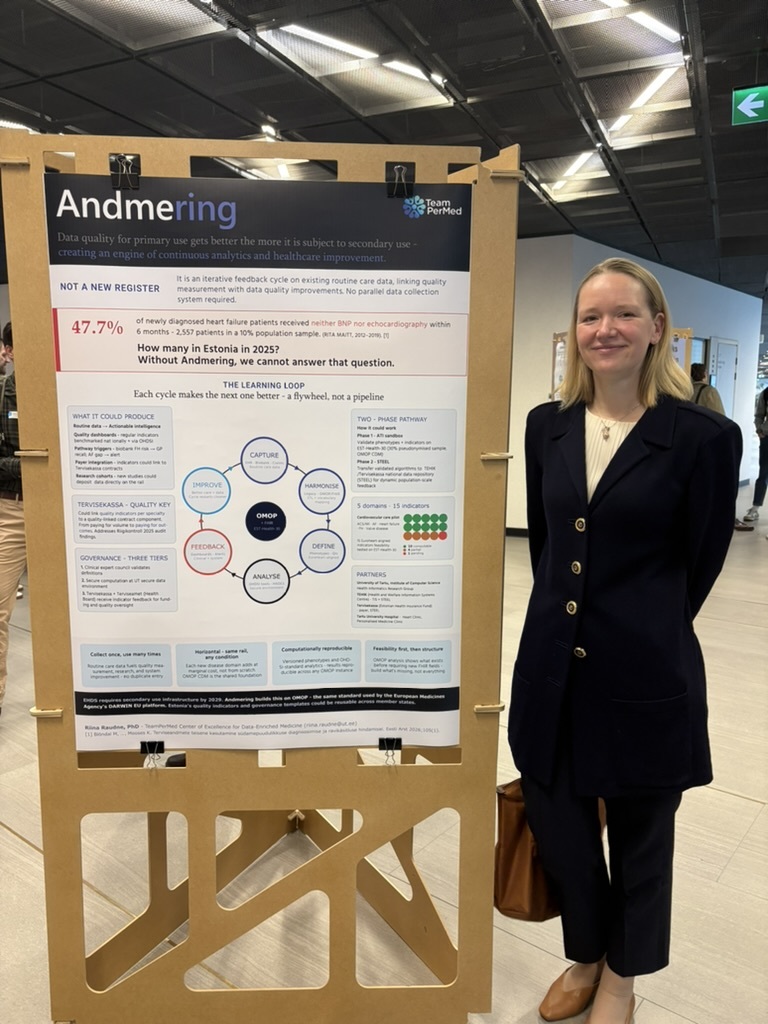
Raudne notes that Andmering itself is not yet complete:
“The whole point is to go through the full cycle. We have done a lot to collect health data and store it securely, but learning from them is the real next challenge, and it is a very large organisational one. We have not been through that yet, but we want to get to a point where we can learn faster and at scale,”
Riina Raudne, first author of the article
Andmering is the result of co-creation between researchers, clinicians and public-sector partners. TeamPerMed thanks the authors of the article, Riina Raudne, Artur Novek, Taavi Lai, Kerli Mooses, Monika Prits, Raivo Kolde, Patrick Pihelgas, Sulev Reisberg, Jaak Vilo and Alar Irs, as well as the leadership of Tervisekassa and TEHIK and partners at the Ministry of Social Affairs for their trust and willingness to experiment.